

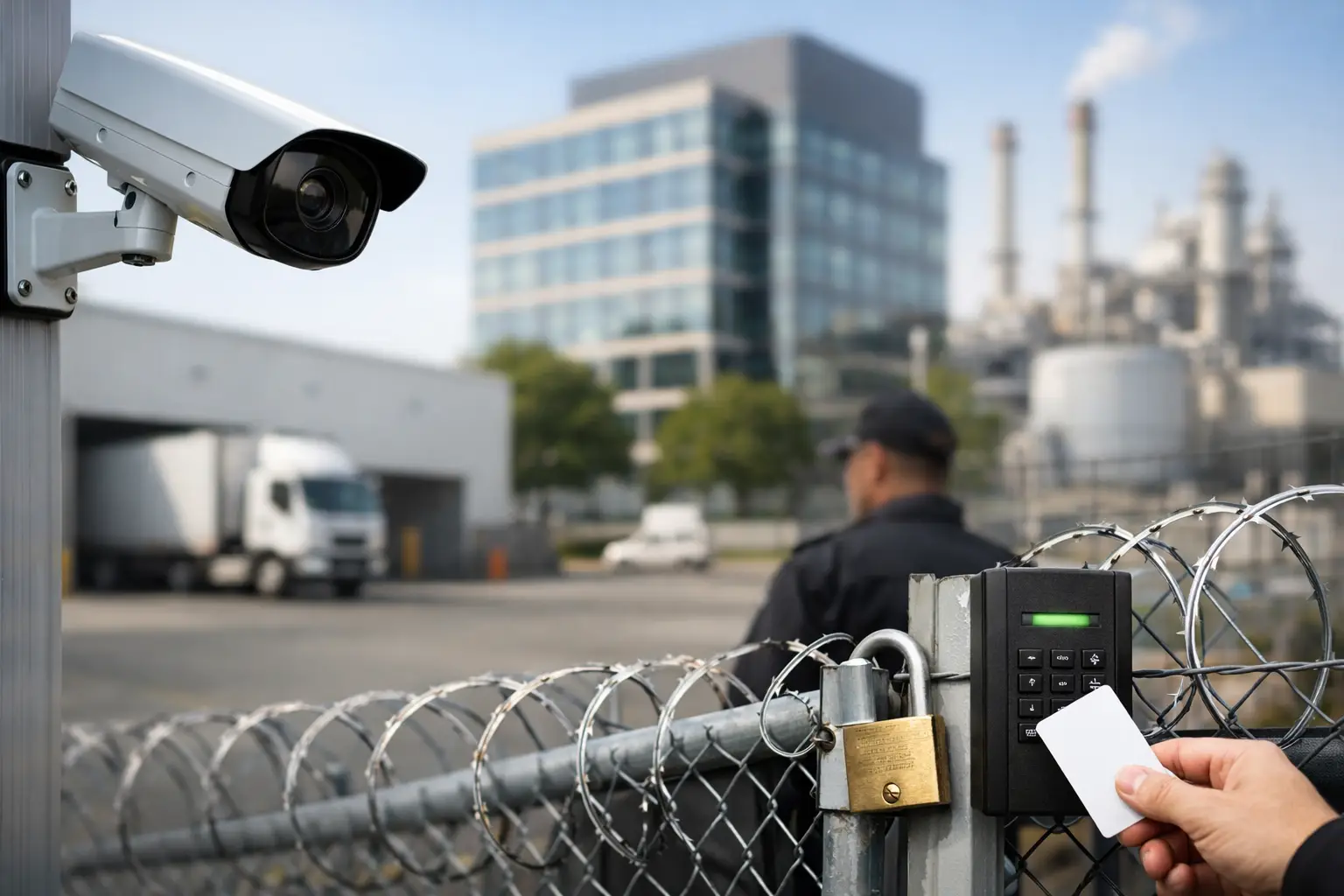
A broken camera at one location, a propped-open rear door at another, and a badge still active for a former employee at a third – this is how multi-location risk usually shows up. If you are figuring out how to secure multi site facilities, the challenge is rarely a single weak point. It is inconsistency between sites, systems, vendors, and day-to-day procedures.
For business owners, property managers, and operations teams, the right approach is not to copy and paste the same setup everywhere. A warehouse, office, retail site, medical facility, and industrial yard do not carry the same risk. The goal is to create one security strategy with site-specific execution, so every location is protected to the right standard and managed from a clear central framework.
How to secure multi site facilities without creating blind spots
Most multi-site security problems start when each location evolves on its own. One branch installs cameras years apart from another. A third site adds access control from a different provider. Cabling gets patched instead of upgraded. Before long, leadership has limited visibility, local managers are handling security differently, and simple tasks like reviewing footage or changing user permissions become harder than they should be.
A better model starts with standardization. That does not mean every site gets the exact same hardware count or identical camera layout. It means your business defines common standards for surveillance quality, access credentials, user permissions, visitor management, cabling infrastructure, alarm response, and remote administration. Once those standards are in place, each site can be designed around its actual traffic, footprint, and exposure.
This is where many organizations save money in the long run. Standardized design reduces training issues, shortens troubleshooting time, and makes future expansion easier. It also helps avoid a common problem in commercial environments – paying multiple vendors to support disconnected systems that do not communicate well with each other.
Start with a site-by-site risk assessment
If you want to know how to secure multi site facilities effectively, begin with an honest review of each property. Not all locations deserve the same level of investment, but each one should be evaluated using the same criteria.
Look at what each site is protecting. That may include inventory, equipment, sensitive data, restricted areas, employee safety, after-hours operations, or public-facing entrances. Then review how people actually move through the property. A site with regular deliveries, shift changes, and contractor access needs a different security posture than an administrative office with limited foot traffic.
Physical layout matters just as much. Large parking lots, blind corners, detached storage areas, and poorly lit perimeters increase exposure. Older facilities often have another challenge: infrastructure that was never designed for modern surveillance, access control, or high-bandwidth data needs. In those cases, your security plan may also need to address fiber optic cabling, network readiness, or power availability before new devices can perform the way they should.
A useful assessment also includes process gaps. Ask who can grant access, who reviews incidents, how footage is retained, and whether there is a consistent lockdown or emergency response procedure. Many businesses discover that their biggest vulnerability is not missing equipment. It is unclear responsibility.
Build one integrated system, not a stack of separate tools
The strongest multi-site environments are built around integration. Cameras, access control, intercoms, and network infrastructure should support each other rather than operate in isolation.
For example, when access control and video surveillance are aligned, your team can verify who entered a door, when they entered, and whether the credential use matched the event. That is far more useful than seeing a door transaction in one platform and unrelated video in another. The same applies to intercom systems at gated entries, delivery areas, or secured lobbies. When these systems are planned together, they support faster decisions and better accountability.
AI-powered CCTV can also improve how larger organizations monitor multiple locations. Instead of relying only on passive recording, smart analytics can flag line crossing, unauthorized area access, loitering, or unusual movement patterns. That does not remove the need for human review. It simply helps teams focus attention where it matters most, especially when one person may be overseeing several sites remotely.
There is a trade-off here. More intelligence and integration can create stronger oversight, but only if the system is configured correctly. Poor camera placement, inconsistent naming conventions, weak retention policies, or bad network planning can limit the value of even advanced hardware. Commercial security works best when the design is tied to operations, not just product features.
Standardize access control across every location
If one issue causes repeated headaches in multi-site environments, it is access management. Different badge formats, different rules, and local workarounds create risk fast.
A modern access control platform gives leadership a better way to manage credentials across the portfolio. Users can be added, removed, or adjusted centrally. Permissions can be based on role, location, schedule, or department. Temporary credentials can be issued for vendors or visitors without compromising permanent access rules.
This matters when staffing changes happen quickly. A terminated employee should not remain active at one site because that location manages its own system differently. A regional manager should not need five separate credential processes for five buildings. Centralized access control reduces those gaps and creates a cleaner audit trail when questions come up later.
That said, standardization should still allow for local conditions. A distribution facility may require tighter after-hours restrictions and more door monitoring than a small office. The platform should be consistent, while permissions and door logic reflect the actual site.
Do not overlook cabling and network infrastructure
Security systems are only as dependable as the infrastructure behind them. This is one of the most overlooked parts of multi-site planning.
When a business expands by adding cameras and door hardware onto aging or poorly documented wiring, problems follow. Devices lose connectivity, video quality suffers, troubleshooting takes longer, and future upgrades become more expensive. In larger facilities or campuses, fiber optic cabling may be the right move to support long distances, stronger bandwidth, and cleaner communication between buildings.
Voice and data infrastructure also plays a bigger role than many buyers expect. If your locations depend on stable communications, remote monitoring, cloud-managed credentials, or integrated intercom use, your low-voltage backbone needs to support it. Security should not be treated as separate from the broader building technology environment.
For many Southern California businesses managing warehouses, office properties, and mixed-use commercial sites, this is where a single qualified low-voltage and security partner becomes valuable. One provider can design the physical security layer and the infrastructure beneath it, which usually leads to better performance and fewer coordination issues during installation.
Create clear monitoring and response standards
Technology alone will not secure a portfolio of buildings. Every site needs a clear operating standard for what happens when something goes wrong.
That includes who receives alerts, who reviews footage, how incidents are escalated, and what local staff are expected to do after hours. A camera alert is only useful if someone understands whether to dispatch, document, or dismiss it. The same applies to forced-door events, intercom calls, or unusual activity identified through analytics.
This is where central oversight and local accountability need to meet. Corporate or regional leadership should define reporting expectations, retention rules, and investigation procedures. Site leadership should understand daily practices, site-specific risks, and emergency contacts. Without both, one location becomes over-managed while another is left to improvise.
Plan for growth from the beginning
A good multi-site strategy should work for the buildings you have now and the ones you may add next year. That affects hardware selection, software licensing, credential structure, and network design.
Scalability does not always mean buying the most complex system available. It means choosing a platform that can absorb new doors, cameras, users, and locations without forcing a complete replacement later. It also means documenting standards so new sites can be onboarded faster and with fewer surprises.
For organizations expanding across Ontario, Rancho Cucamonga, Los Angeles, or nearby commercial markets, consistency matters even more because facilities often vary widely in age, layout, and use case. A scalable design keeps those differences manageable.
Professional installation matters more in multi-site security
Multi-site systems leave less room for guesswork. Small installation mistakes repeat themselves across the portfolio. Improper field of view, poor reader placement, bad cable termination, and weak device labeling all create downstream problems that multiply with every additional site.
Professional commercial installation helps prevent that. It also supports code awareness, cleaner documentation, better system commissioning, and more reliable handoff to the people who will manage the environment every day. Resource One Low Voltage Security works with commercial clients that need this kind of integrated approach because the technology only pays off when it is designed and installed around the realities of the business.
The best time to fix fragmented security is before the next incident forces the issue. When every location follows a common strategy, your team gains more than coverage – you gain control.