

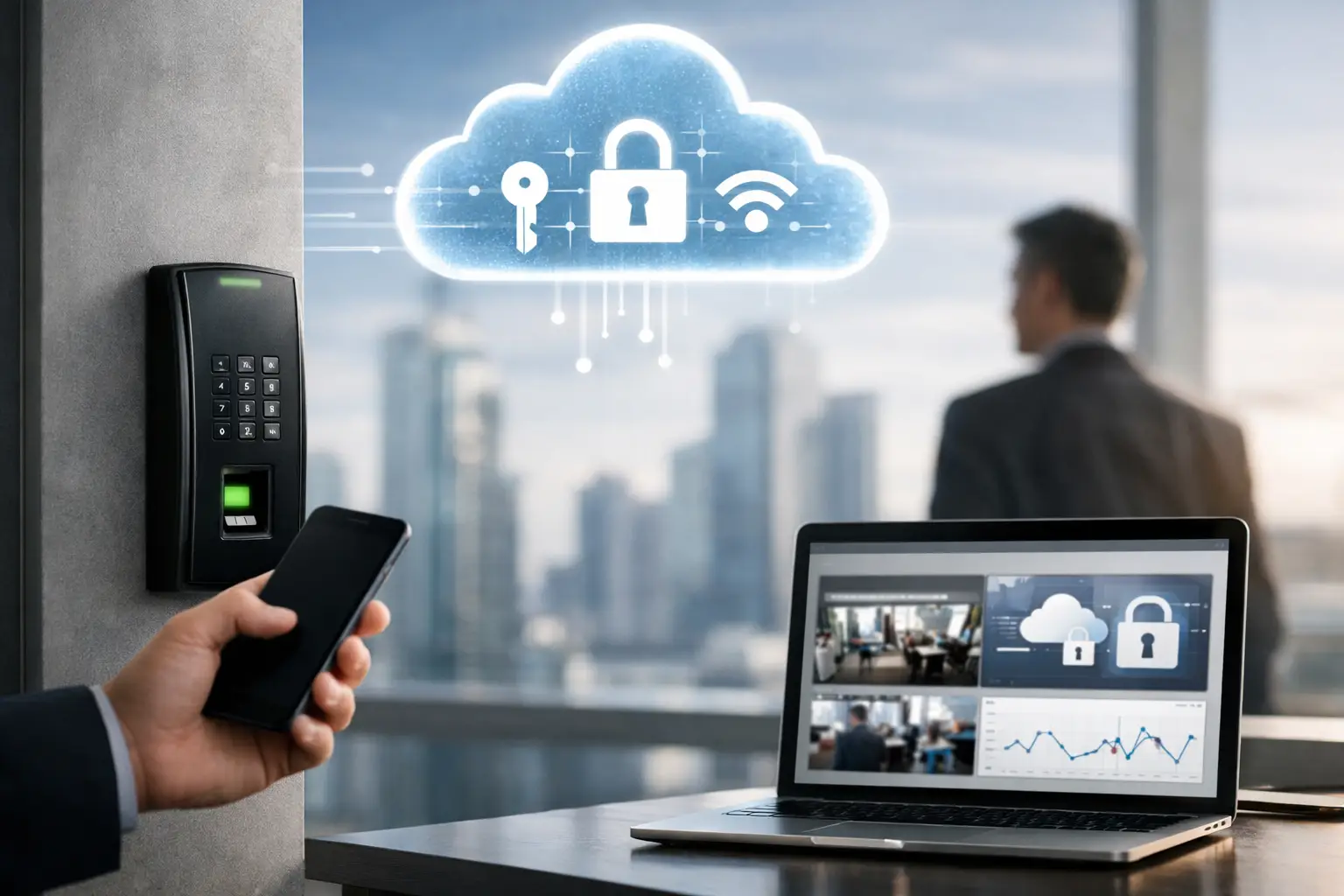
A lost key used to be a minor headache. For a business, it can be a security gap, a rekeying expense, and a disruption that pulls staff away from real work. That is exactly why cloud based access control for business has moved from a nice upgrade to a serious operational decision for offices, warehouses, retail sites, medical facilities, and multi-tenant commercial properties.
Traditional access systems still have a place in some buildings, but they often create friction. Someone has to manage cards on-site, update user permissions manually, track down who has access to which door, and respond when a lock, credential, or panel issue appears after hours. For companies with multiple entry points or changing staff, that model gets expensive fast.
Cloud-managed access control changes the day-to-day reality. Instead of being tied to one on-premise workstation or an aging panel setup, authorized managers can handle users, schedules, doors, and audit trails from a secure web dashboard or mobile app. The result is not just convenience. It is better visibility, faster response, and tighter control over who can enter specific areas and when.
What cloud based access control for business actually means
At its core, this system connects your doors, readers, credentials, and management software through the cloud. Your business can issue or revoke access remotely, review activity logs, create schedules, and manage multiple locations without needing to be physically present at every site.
That does not mean every part of the system lives only online. The door hardware, locks, readers, and controllers are still installed on-site, and professional design matters. If internet service drops, a properly configured commercial system should still maintain local door functionality based on its last approved rules. That is one of the reasons installation quality and product selection matter so much.
For many businesses, mobile credentials are a major advantage. Employees can use a smartphone instead of a physical key or badge, while managers can send temporary credentials to contractors, cleaning crews, or vendors without meeting them in person. It is a practical change that reduces lost credentials and shortens response time when access needs change.
Why businesses are moving away from keys and older systems
The biggest reason is control. Physical keys are hard to track, easy to copy, and expensive to replace once they circulate beyond your current staff. Older electronic systems improve on keys, but many still depend on local software, inconsistent updates, and limited remote management.
Businesses today need more flexibility than that. Staff schedules shift. Tenants change. Delivery and service vendors need limited access. Some facilities have public-facing entrances in one area and restricted rooms in another. When access rules change often, cloud systems make that manageable.
There is also a wider business case. Access control is no longer just about opening doors. It is part of your security strategy, your internal accountability, and your day-to-day operations. When paired with cameras, intercoms, and reliable low-voltage infrastructure, it becomes easier to investigate incidents, manage visitors, and reduce the manual work tied to facility security.
Where cloud based access control for business delivers the most value
For a single small office, the value may be simple. You want to stop using keys, know when employees arrive, and avoid calling a locksmith every time staffing changes. For a larger commercial site, the value grows quickly.
Property managers can control access for common areas, service gates, and tenant-specific doors with more precision. Operations managers can set schedules for back-of-house entries, inventory rooms, and loading areas. Businesses with more than one location can standardize permissions and reporting without juggling a separate system for each building.
This is especially useful in Southern California commercial environments where multi-site operations, shared business parks, and expanding facilities are common. A company may have an administrative office in one city, a warehouse in another, and a retail or service location somewhere else. Managing all of that from one platform saves time and reduces blind spots.
Healthcare offices, schools, industrial buildings, and professional service firms also benefit because they often need layered access. The front office may be open to staff and approved visitors, while records rooms, IT closets, and executive spaces require tighter permissions. Cloud systems make those layers easier to administer without overcomplicating daily use.
The real advantages and the real trade-offs
The advantages are clear. Remote management is faster. Audit trails are easier to review. Access changes happen in minutes instead of days. Expansion is simpler when your company adds users, doors, or locations. And mobile credentials often reduce card replacement costs and front desk friction.
But a smart buyer should also look at the trade-offs. Cloud systems usually involve recurring software costs. Some businesses prefer that model because it spreads expense over time and includes ongoing platform improvements. Others want to limit monthly commitments and need help comparing total cost over several years.
Internet reliance is another factor. A well-designed system should not fail just because connectivity drops, but your infrastructure still matters. If your building has poor network design, weak cabling, or inconsistent power protection, access control performance can suffer. That is why access control should never be treated as a standalone gadget purchase. It is part of a larger commercial low-voltage environment.
There is also the issue of platform selection. Not every system fits every property. A fast-growing business may prioritize scalability and simple user management. A high-security facility may focus more on credential policies, door monitoring, reporting depth, and integration with video. It depends on your risk profile, staffing model, and building layout.
What to look for in a commercial access control system
The software matters, but the hardware and installation matter just as much. A strong system starts with the right door hardware, readers, controllers, and network readiness. If those pieces are mismatched, even good software will not fix the problem.
Look for a platform that makes it easy to assign user roles, create schedules, review events, and manage credentials remotely. If your team is not highly technical, the interface should be simple enough for daily use without constant support calls. Good access control should give managers more control, not more administrative burden.
It also makes sense to consider integrations. Many businesses benefit when access events can be paired with security camera footage or intercom activity. If a door is forced open, if someone enters after hours, or if a delivery person requests access, connected systems give you faster context. That saves time during investigations and improves response.
Scalability should be part of the conversation from the beginning. Even if you only need a few doors today, your system should support additional entries, sites, and user groups later. Replacing a system too early because it could not grow with your business is a costly mistake.
Why professional installation matters more than most buyers expect
Commercial access control is not a plug-and-play purchase. Every site has different entry points, life safety considerations, tenant requirements, and infrastructure limitations. A poorly planned system can create bottlenecks at entrances, unreliable door behavior, code issues, and expensive rework.
Professional installation starts with a site-specific design. That includes evaluating door types, lock hardware, reader placement, power needs, network connectivity, cabling paths, and user flow. It also means planning for the way your business actually operates, not just the way a product brochure says it should.
This is where working with a commercial security and low-voltage specialist matters. Businesses need more than a box of equipment. They need a system that fits their property, supports compliance and safety, and works consistently under daily use. Resource One Low Voltage Security approaches access control that way, as part of a larger business infrastructure strategy rather than an isolated device install.
Is cloud based access control for business right for your facility?
In many cases, yes, but not automatically. If your business struggles with key control, staff turnover, after-hours access requests, or multi-site management, a cloud system is often a strong fit. If you want better reporting, easier credential updates, and tighter oversight without being tied to one office computer, the value is immediate.
If your facility has unusual security requirements, older doors, network limitations, or strict compliance needs, the answer may still be yes, but the design process becomes more important. The right system is the one that matches your risk level, your building conditions, and your operational needs.
The best first step is not choosing a brand from a brochure. It is getting a real assessment of how your property functions, where your vulnerabilities are, and how access control can support the way your business runs. When the system is designed correctly, you do not just get smarter doors. You get better control over your building, your people, and your daily operations.
If your current setup still depends on keys, outdated software, or disconnected security tools, this is a good time to rethink it. The right access control system should make your business safer and easier to manage at the same time.