

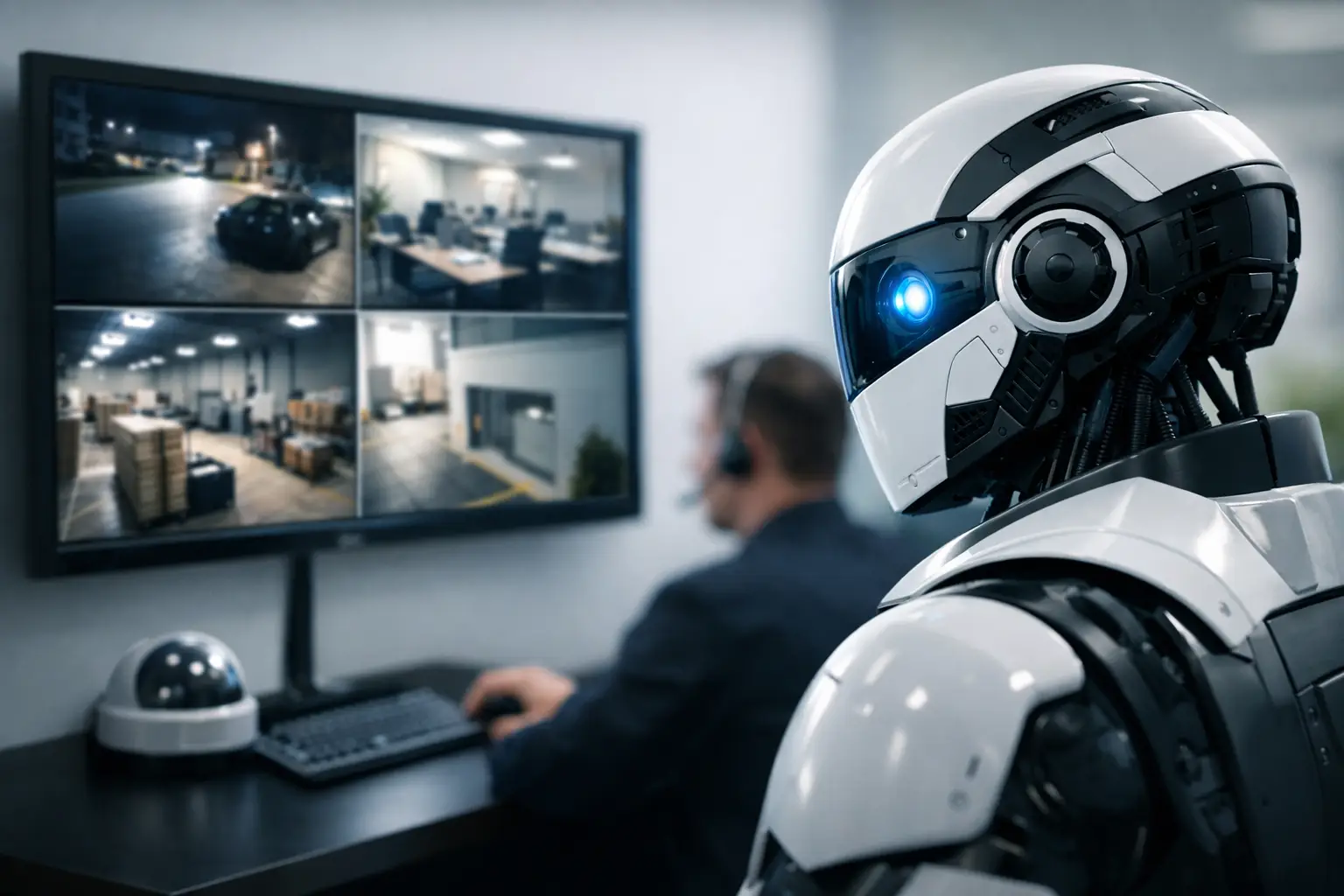
A delivery truck pulls up after hours, a side gate opens, and someone steps into a yard that should be empty. In a traditional setup, that activity might sit unnoticed on recorded video until the next morning. An ai virtual guard changes that timeline. Instead of waiting for someone to review footage later, the system watches live conditions, flags unusual behavior, and helps your team respond while the event is still happening.
For commercial properties, that difference matters. Theft, trespassing, liability claims, and operational disruptions rarely happen on a convenient schedule. Business owners and facility managers need more than cameras that simply record. They need systems that can identify real events, reduce noise from false alarms, and support faster decision-making across warehouses, offices, retail locations, parking areas, and industrial sites.
What an AI virtual guard actually is
An AI virtual guard is not a single device. It is a security approach that combines AI-enabled cameras, analytics, remote monitoring logic, event-based alerts, and clearly defined response workflows. The goal is straightforward: detect activity that matters and prompt action sooner.
That can include identifying people in restricted areas, vehicles entering after hours, loitering near entrances, movement around loading docks, or unusual patterns in perimeter zones. Depending on the system design, the technology can distinguish between a person, a vehicle, an animal, shifting light, or weather movement. That filtering is what makes the concept useful in commercial environments. If every tree branch or shadow creates an alarm, the system becomes background noise. If the system is tuned properly, it becomes a practical security tool.
This is also where many business buyers need a reality check. AI does not replace every security function, and it does not eliminate the need for good camera placement, network reliability, lighting, or access control. It improves visibility and response when the underlying infrastructure is designed correctly.
Why businesses are moving toward AI virtual guard systems
The main driver is not novelty. It is efficiency.
A standard CCTV system gives you video evidence. That has value, especially after an incident. But many companies now want more from their investment. They want their security system to help prevent loss, not just document it. An AI virtual guard supports that goal by turning passive surveillance into active monitoring.
For a property manager, that may mean getting an alert when someone enters a pool equipment area, roof access point, or rear service corridor. For a warehouse operator, it may mean monitoring trailer yards, fence lines, and dock doors after business hours. For an office or medical facility, it may mean improved oversight of entry points and parking areas without forcing staff to watch live feeds all day.
There is also a staffing reality behind this shift. Very few organizations have the time or budget to assign employees to constant video review. Security teams are already balancing multiple responsibilities. AI helps direct attention where it belongs. Instead of watching eight hours of normal activity, staff can review the handful of moments that need action.
Where an AI virtual guard works best
The strongest results usually come from sites with clear security rules and predictable activity patterns. Commercial properties with defined access hours, perimeter boundaries, restricted areas, and repeat traffic flows are ideal candidates.
Warehouses, distribution yards, office campuses, retail centers, contractor yards, multifamily common areas, schools, and industrial facilities can all benefit. In Southern California, where many businesses operate across large footprints with outdoor exposure, after-hours vulnerability is a real concern. Parking lots, alley access, loading zones, and detached structures are common weak points.
That said, not every area needs the same level of AI monitoring. A front lobby during staffed business hours may not require advanced intrusion analytics. A rear gate with limited visibility probably does. Good system design starts with risk priorities, not a blanket approach.
The difference between smart detection and false confidence
This is where buyers should ask better questions.
Some systems are marketed as intelligent simply because they can send motion alerts to a phone. That is not the same as an AI virtual guard strategy. Basic motion detection often creates too many irrelevant notifications to be useful. Rain, headlights, insects, and environmental movement can flood users with alerts until they stop paying attention.
A true commercial-grade setup uses analytics that are configured around the site. Detection zones, object recognition, timing rules, camera angles, and response triggers all need to be calibrated. The system should know the difference between expected daytime traffic and suspicious overnight activity. It should also account for the operational rhythm of the property.
This is one reason professional installation matters. AI is only as effective as the camera views, network performance, power stability, and programming behind it. A poorly placed camera with bad glare and weak coverage will not become reliable just because analytics are added later.
AI virtual guard and access control work better together
Video intelligence becomes more valuable when it is paired with other systems.
If an access-controlled door is forced open, the camera can immediately capture and flag the event. If a gate opens after hours, operators can verify whether the activity matches an authorized credential use or a security concern. If an employee enters a restricted area at an unusual time, the combined data creates a clearer picture of what happened and when.
For commercial clients, this integrated approach often creates better operational control as well. Security is not only about stopping intruders. It is also about documenting events, supporting investigations, protecting staff, and reducing uncertainty. When video, access control, and network infrastructure are designed as part of one system, the result is stronger coverage and fewer blind spots between vendors.
What business owners should expect from implementation
The best AI virtual guard deployments begin with a site assessment. That includes reviewing property layout, lighting conditions, camera coverage gaps, current security pain points, network capacity, and response expectations. A parking lot with frequent overnight traffic needs a different strategy than a professional office with one public entrance.
From there, the system should be designed around business priorities. Some companies want stronger perimeter awareness. Others need tighter monitoring at gates, dock doors, inventory areas, or shared tenant spaces. There is no single default package that fits every commercial property.
Buyers should also expect discussion around response. Who receives alerts? What happens after verification? Is the goal to notify on-site staff, management, a security team, or a remote monitoring partner? Detection without a defined response process leaves value on the table.
Trade-offs to understand before you invest
AI can improve security performance, but it is not magic.
First, there is an upfront cost difference between a basic recording system and a well-designed AI-enabled platform. Many businesses find the added visibility worth it, especially when high-value assets, liability exposure, or recurring trespass issues are involved. Still, the return depends on the site and the problem being solved.
Second, more data does not automatically mean better outcomes. If alerts are not tuned properly, users can still experience fatigue. If camera placement ignores lighting or line-of-sight issues, analytics will be less dependable. If internet or network infrastructure is weak, remote access and event delivery can suffer.
Third, privacy and policy matter. Businesses should be clear about where monitoring is appropriate, how footage is stored, who has access, and how long event data is retained. Commercial security decisions should support both protection and compliance.
Choosing the right partner for an AI virtual guard system
For most businesses, the technology itself is only half the decision. The other half is choosing a contractor that understands commercial environments.
That means looking for experience with camera systems, low-voltage infrastructure, access control, and site-specific design. It also means working with a licensed, bonded, and insured provider that can evaluate the property as an operating business, not just a collection of hardware locations.
In markets such as Ontario, Rancho Cucamonga, Los Angeles, and surrounding areas, many facilities deal with a mix of public access, employee traffic, deliveries, and after-hours exposure. Those conditions call for practical planning, not generic recommendations. Resource One Low Voltage Security focuses on that kind of commercial implementation, where security performance depends on how well each part of the system works together.
An AI virtual guard is most effective when it is built around the realities of the site. The right setup helps your business catch meaningful events earlier, respond with more confidence, and stop relying on footage that only explains what went wrong after the fact. If your current cameras are mostly serving as a record of yesterday’s problems, it may be time for a system that does more while the day is still in motion.