

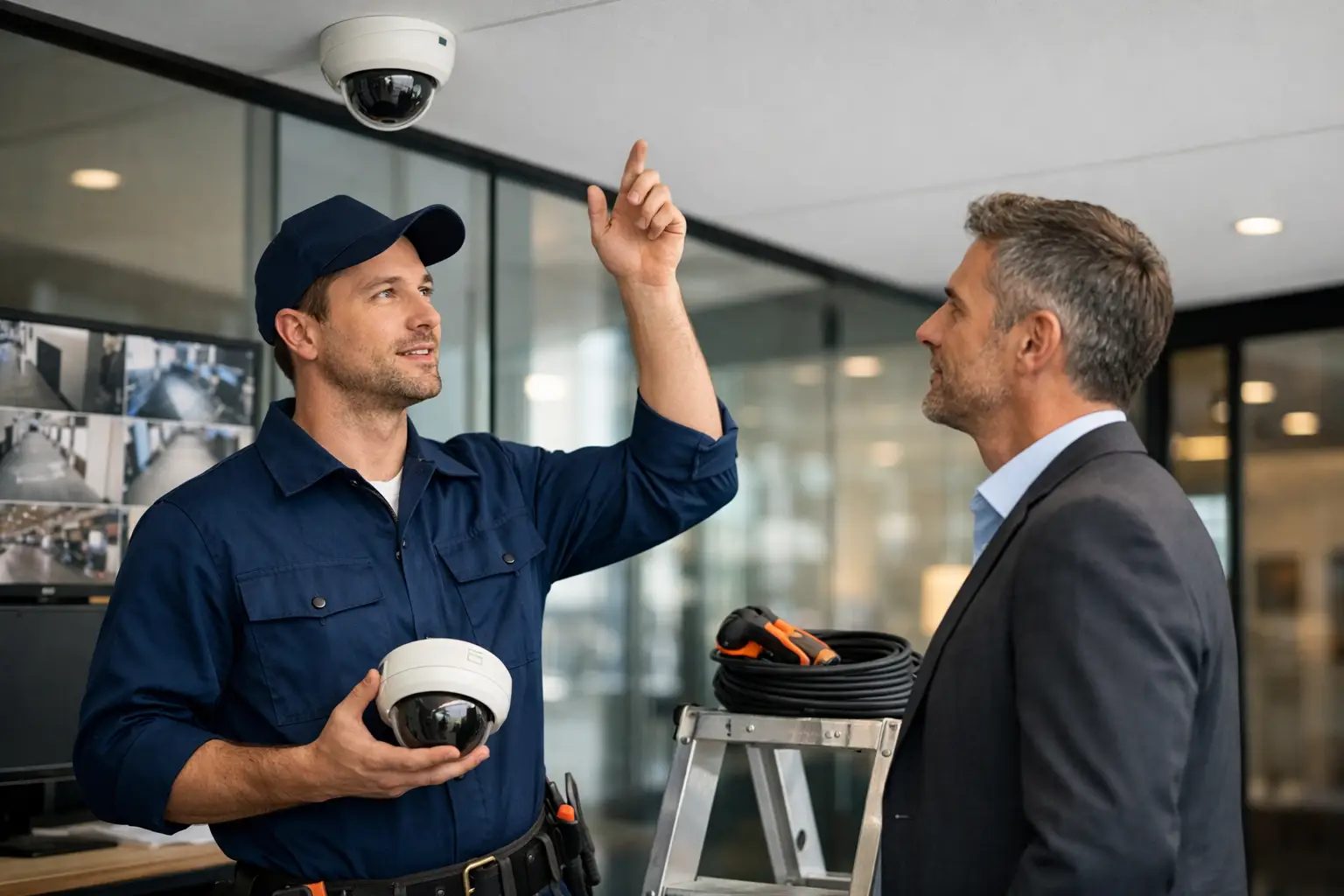
A camera system can look impressive on paper and still fail where it matters most – coverage gaps, poor image quality, unreliable remote access, and an installer who disappears after the job is done. That is why learning how to choose commercial CCTV installer services is less about finding the lowest bid and more about selecting a partner who understands business risk, site operations, and long-term system performance.
For commercial properties, CCTV is not a basic commodity purchase. A warehouse, office, retail center, medical facility, school, or industrial site all have different traffic patterns, liability concerns, and infrastructure requirements. The installer you choose should be able to design around those realities, not just mount cameras where it is easiest.
How to choose commercial CCTV installer for a business site
Start with commercial experience, not general handyman or residential alarm experience. Commercial surveillance projects often involve multi-building layouts, network integration, access control coordination, storage planning, after-hours installation scheduling, and compliance concerns. An installer who mainly works on homes may offer a lower price, but that does not mean they are equipped to support a business environment.
Ask what types of commercial properties they regularly serve. If they have worked with offices, manufacturing facilities, retail spaces, apartment communities, logistics sites, or mixed-use properties, they are more likely to understand practical issues such as loading dock coverage, employee entrances, visitor management, parking lot visibility, and camera placement that avoids blind spots without disrupting operations.
Licensing, bonding, and insurance should be non-negotiable. In commercial work, this protects your business if something goes wrong during installation and signals that the company operates professionally. If a contractor hesitates to provide this information, move on. Security infrastructure is too important to leave to an unverified vendor.
It also helps to ask who will actually perform the work. Some companies sell the project and subcontract the installation to crews you never meet until the job starts. That is not always a problem, but you should know in advance who is responsible for workmanship, testing, training, and follow-up support.
Look beyond camera counts and price
One of the most common mistakes buyers make is comparing quotes by camera quantity alone. More cameras do not automatically mean better protection. A well-designed system with the right lens selection, placement, recording settings, and lighting awareness can outperform a larger system that was installed without a site strategy.
A strong installer should begin with a site assessment. They should ask what you are trying to protect, what incidents you are trying to prevent or document, who needs access to footage, and how your team operates day to day. If the conversation jumps straight to package pricing, that is a warning sign.
Commercial CCTV design should reflect the way your property actually functions. A front office may need high-quality facial capture at entry points. A parking area may need wider coverage and strong low-light performance. A distribution facility may need vehicle tracking, perimeter visibility, and camera retention policies that support investigations. Different objectives require different solutions.
This is also where advanced features should be discussed honestly. AI-powered analytics, auto-tracking cameras, license plate capture, line-crossing alerts, and smart search tools can add real value. But not every site needs every feature. A dependable installer will explain where those tools improve security and where they may add unnecessary cost.
Ask how the system fits your network and operations
A commercial CCTV system is not just cameras and a recorder. It is part of your broader low-voltage and technology environment. That means your installer should understand bandwidth, storage, structured cabling, remote viewing permissions, cybersecurity basics, and how surveillance may need to work alongside access control, intercoms, or other systems.
If your business already has network constraints, older cabling, multiple buildings, or limited IT support, those issues need to be addressed before installation begins. Otherwise, you risk a system that performs poorly under real conditions. Choppy video, dropped connections, and unreliable remote access usually point to poor planning, not bad luck.
This is especially important for growing businesses. If you may add doors, buildings, parking areas, or departments over time, ask whether the proposed system can scale without forcing a full replacement. The right installer should think beyond your immediate need and help you avoid decisions that box you in later.
For many Southern California businesses, this matters because sites are often spread across warehouses, offices, gated lots, and customer-facing spaces. A local commercial installer with experience in markets such as Ontario, Rancho Cucamonga, Los Angeles, and surrounding areas is more likely to understand the operational pace and property layouts common in the region.
How to evaluate a commercial CCTV installer before signing
The best proposals are clear, specific, and tied to outcomes. You should be able to see what equipment is being recommended, why it is being recommended, where it will be installed, and what support is included after the work is complete. Vague estimates create expensive misunderstandings later.
Ask direct questions about image quality expectations, nighttime performance, mobile access, retention time, user training, and service response. If you need evidence-grade footage at certain locations, say so. If multiple managers need different access levels, say that too. Good installers welcome these conversations because they lead to better design.
Pay attention to how they handle trade-offs. For example, cloud storage may offer convenience, but ongoing costs can be higher. Higher resolution cameras provide more detail, but they also demand more storage and bandwidth. Wide-angle views cover more area, but they may reduce usable detail at distance. A credible installer will walk you through these decisions rather than pretending every option is equally ideal.
You should also ask about maintenance and support after turnover. Cameras need firmware updates, occasional adjustments, health checks, and troubleshooting. If a company is difficult to reach before the sale, it will not become easier to reach after installation. Commercial clients need responsive support, especially when surveillance ties directly to liability and incident response.
References and project examples can help, but they are most useful when they match your environment. A retail client reference may not tell you much if you operate a warehouse complex. Look for proof that the installer has solved problems similar to yours.
Red flags that should slow you down
Some warning signs are easy to miss because they sound appealing at first. Extremely low bids often leave out critical components such as proper cabling, storage capacity, surge protection, cleanup, user training, or post-install support. You may save money upfront and spend more correcting the job later.
Another red flag is a one-size-fits-all recommendation. Commercial security works best when it is tailored. If every property gets the same recorder, the same cameras, and the same layout regardless of risk profile or operating hours, the design process is not being taken seriously.
Be cautious if the installer cannot explain the difference between deterrence coverage and identification coverage. Seeing that an event happened is not the same as clearly identifying a face, badge, or license plate. Businesses often assume they are getting one when the proposal only delivers the other.
It is also worth watching for poor communication. Delayed follow-up, unclear scope, rushed walkthroughs, and inconsistent answers usually point to bigger project management issues. In commercial environments, professionalism matters because the work often has to fit around staff, customers, tenants, vendors, and business hours.
Choose a security partner, not just an installer
The right CCTV company should make your operation easier to protect, easier to manage, and easier to expand. That means thinking past installation day. Can they support future camera additions, integrate with access control, improve cabling infrastructure, or help centralize security across multiple areas of your property? If the answer is yes, you are likely talking to a long-term partner instead of a one-time vendor.
For business owners and facility leaders, that distinction matters. Security decisions affect liability, employee safety, operational visibility, and peace of mind. When the system is designed correctly and installed professionally, it becomes a practical business tool, not just another line item.
If you are weighing proposals right now, slow the process down enough to ask better questions. The cheapest option is rarely the least expensive over the life of the system, and the flashiest proposal is not always the best fit. Choose the company that understands your site, explains trade-offs clearly, and treats your security like an operational priority. Don’t leave your commercial security to chance.