

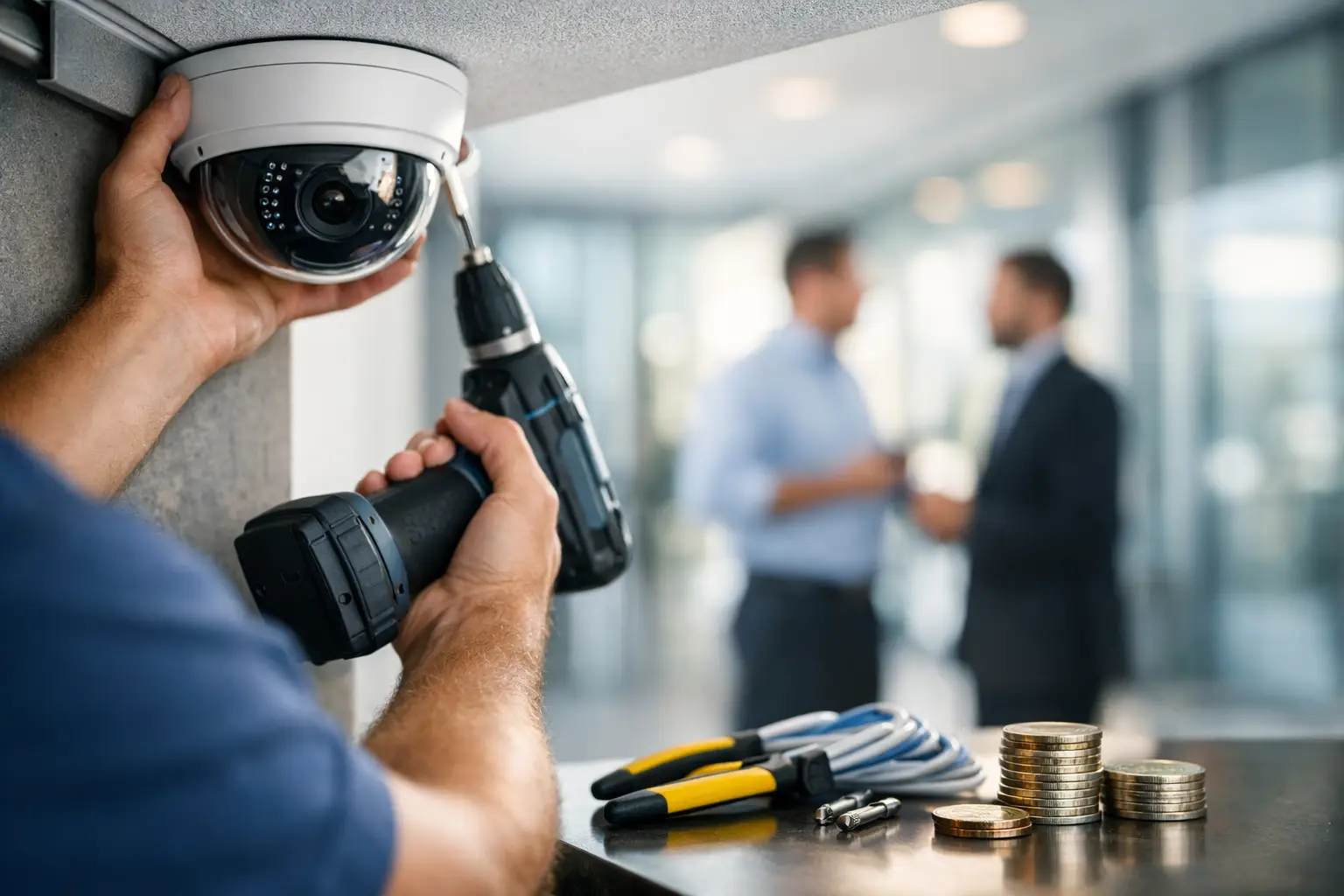
A two-camera setup at a small storefront and a 60-camera system across a warehouse, office, and parking lot can both be called “video surveillance,” but their budgets will look nothing alike. That is why commercial security camera installation cost is never just about the price of a camera. For businesses, the real cost comes from system design, coverage goals, building conditions, storage requirements, network demands, and the quality of the installation itself.
If you are budgeting for a new system or replacing an outdated one, the right question is not “What does a camera cost?” It is “What will it take to secure this property properly without creating new blind spots, maintenance issues, or network problems later?” That is the standard commercial buyers should use.
What affects commercial security camera installation cost?
The biggest cost factor is scope. A basic system for a small office may need only a few fixed cameras, a recorder, and straightforward cable runs. A larger commercial property may need multiple camera types, higher resolution, longer cable pathways, network switches, remote viewing setup, and storage sized for compliance or internal policy.
Camera count is the starting point, but it is not the whole story. Ten cameras installed in easy-to-access interior locations can cost less than six cameras mounted outdoors at height, with trenching, conduit, or difficult cable pathways. Labor, lift access, weather-rated hardware, and site conditions matter just as much as equipment.
The type of business also changes the design. Retail stores often prioritize entrances, registers, aisles, and parking areas. Industrial sites may need perimeter coverage, loading docks, yard visibility, and long-range views. Office properties may place more emphasis on lobbies, access points, visitor management, and after-hours activity. Each use case affects both hardware selection and installation time.
Typical commercial security camera installation cost ranges
Most businesses should expect commercial security camera installation cost to fall into a broad range rather than a flat number. For a smaller commercial property, a professionally installed system may start in the low thousands. Mid-size systems often land in the mid-to-upper thousands. Large or multi-building installations can move well beyond that, especially when they include advanced analytics, license plate capture, fiber runs, or integration with access control.
A useful planning framework looks like this:
- Small business locations with limited coverage needs often budget roughly $3,000 to $8,000.
- Mid-size properties with broader interior and exterior coverage often fall around $8,000 to $25,000.
- Larger commercial sites, warehouses, campuses, and specialized facilities can range from $25,000 upward.
These are planning numbers, not quote substitutes. A clean office in an accessible building is very different from a distribution site with parking lots, detached structures, and low-light perimeter areas. The more complex the environment, the less useful any national average becomes.
Camera type changes the budget quickly
Not all cameras serve the same purpose, and the wrong mix can either overspend the project or leave key areas underprotected. Fixed dome and bullet cameras are often the most cost-effective foundation for commercial coverage. They work well for entrances, hallways, office areas, and many exterior viewpoints.
PTZ cameras cost more because they do more. They can pan, tilt, zoom, and in some cases auto-track movement using AI. That added capability is valuable in parking lots, larger open areas, and active monitoring environments, but it is not necessary for every location. Using PTZ cameras where fixed coverage would work can inflate costs without improving outcomes.
Higher resolution also affects price. A 4MP or 8MP camera may provide better image detail for identification, but it also increases storage and network demand. For some businesses, that extra detail is worth it. For others, strategic placement matters more than pushing every camera to the highest spec.
Labor, cabling, and building conditions
Installation labor is often underestimated by buyers comparing quotes. Commercial environments vary widely, and a clean install takes planning. Open ceilings are usually easier than finished spaces. Single-story interior cable runs are simpler than multi-story pathways. Existing conduit can help. So can a strong structured cabling backbone.
Older properties can raise costs because they often need infrastructure work before cameras are even mounted. That may include replacing damaged cabling, adding network capacity, extending power, or improving equipment room organization. Newer facilities may be easier, but they are not automatically simple. Large footprints, high ceilings, and strict operating-hour limitations can still add labor.
Outdoor work is another major variable. Parking lots, yards, loading docks, and perimeter fencing often require longer runs, weather-rated components, poles, trenching, or lift equipment. In Southern California, many businesses want strong exterior coverage because vehicle traffic, theft risk, and after-hours activity do not stop at the front door. Those exterior areas are often where project costs increase most.
Storage, remote access, and retention requirements
A surveillance system is not just cameras on walls. Businesses also need recording and retrieval that supports real operational use. That means choosing the right NVR or server setup, determining how many days of footage to retain, and accounting for camera resolution, frame rate, and recording method.
If you want 30, 60, or 90 days of retention, storage requirements can grow fast. Continuous recording costs more than motion-based recording. Higher-resolution cameras require more storage. Multi-site businesses may also need centralized visibility, user permissions, and secure remote access for managers or ownership.
Cloud and hybrid storage models can shift costs as well. They may reduce some on-site hardware demands, but they can introduce recurring fees. For some organizations, that trade-off makes sense because it simplifies management or adds redundancy. For others, an on-premise recording approach is more predictable over time.
AI features and integrations can be worth the extra cost
A standard CCTV system records activity. A smarter system helps a business act on it. AI-based people and vehicle detection, line crossing alerts, intrusion detection, facial search capabilities, and auto-tracking can all increase project cost, but they can also reduce false alerts and improve incident response.
The same is true for system integration. When cameras are connected with access control, intercoms, or broader low-voltage infrastructure, the result is usually more useful than a stand-alone system. A property manager can verify door events with video. An operations team can review warehouse access and shipping activity together. A front office can manage visitor entry with better visibility.
That does not mean every business needs a fully integrated platform on day one. It does mean planning matters. A lower upfront quote may be less attractive if the system cannot scale or integrate later.
Why the cheapest quote often costs more
Commercial buyers already know this from other trades, but security is a category where low bids can create long-term problems. Cheap installations often cut corners on camera placement, cable quality, network design, weather protection, or documentation. The system may technically work at handoff, but it can become unreliable when footage is actually needed.
There is also the issue of business interruption. Poor installation planning can disrupt operations, leave visible wiring, create weak points in the network, or delay the project beyond what was promised. If the installer does not understand commercial environments, the client ends up managing details that should have been handled professionally from the start.
Licensed, bonded, and insured commercial contractors usually price differently for a reason. They are building for reliability, code awareness, liability protection, and long-term serviceability. For a business, that is not overhead. It is risk management.
How to budget the right way
If you are trying to estimate cost internally, start with security objectives, not product counts. Identify what needs to be seen, what events need to be captured, how long footage must be stored, and who needs access to the system. Then look at the building itself. The path to a good estimate is operational, not hypothetical.
It also helps to separate must-haves from future phases. A business may need immediate coverage for entrances, cash handling areas, receiving zones, and parking lot access points now, while leaving room to expand later. That approach often creates a better budget than trying to force the entire vision into phase one.
For properties in markets such as Los Angeles, Ontario, or Rancho Cucamonga, local labor conditions, travel, and site logistics can affect pricing too. A commercial installer familiar with the region can usually identify these variables early and keep the proposal grounded in real-world conditions rather than generic assumptions.
What a professional estimate should include
A useful estimate should do more than name a camera brand and total price. It should reflect the actual site and explain what is included. That means camera quantities and types, recording hardware, storage assumptions, mounting methods, cabling scope, network requirements, and any allowances for lifts, trenching, or special access conditions.
It should also clarify what happens after installation. Commissioning, user training, remote viewing setup, and service support matter. Businesses do not just buy cameras. They buy an operational system that needs to perform when an incident, claim, dispute, or safety concern arises.
Resource One Low Voltage Security works with commercial clients that need that bigger picture – not just equipment on a quote sheet, but a system designed around how the property actually operates.
A security camera system is one of those investments that feels expensive right up until the moment you need clear footage, reliable coverage, and a system that did exactly what it was supposed to do.